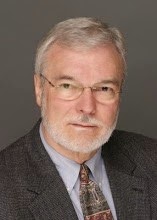
Sen. Bernie Sanders said to Jake Tapper on CNN:
"“This guy ran for president of the United States saying, ‘I’m going to take on Wall Street. These guys are getting away with murder.' And then, suddenly, he appoints all these billionaires. His major financial adviser comes from Goldman Sachs. And now he is going to dismantle legislation that protects consumers. . .
"This is a guy who ran for president saying, ‘I’m . . . not going to cut Social Security, Medicare and Medicaid. And then he appoints all of these guys who are precisely going to cut Social Security, Medicare and Medicaid. . . . I have to say this, Jake. And I don’t mean to be disrespectful . . . [but] this guy is a fraud."
Apparently in Trump's lexicon, there are two meanings to "take on." We naively thought he meant "take them on in a fight." But he "took them on" as members of his cabinet.
Ralph
Monday, February 6, 2017


Appeals Court says No to Trump. What if he defies?
The Justice Department appealed Judge Robart's order that put a nationwide hold on Trump's Muslim ban, asking the court to immediately restore Trump's immigration order. The Appeals Court said No.
There's one more step, of course, the U.S. Supreme Court. If they split 4 to 4, then the Appeals Court decision stands -- and that would be the end of the judicial line for Trump, at least as far as immediate restoration of the ban. It could of course go to a trial, which would be a lengthy process.
Beyond a trial court's consideration of the legality of Trump's ban, Trump has probably poisoned his own case on the issue of context and motivation for the ban. First, he cannot show that these seven countries are the source of previous terrorist activity in the U.S. And they've said nothing publicly about having intelligence of plots or plans for future attacks.
There is video footage of Rudy Giuliani saying that Trump wanted "a Muslim ban" and asked him to help devise a way to make it legal. Big-mouth Rudy spilled the beans (or is he getting revenge on Trump for not appointing him AG?). Playing that video would be devastating in a courtroom where you're trying to prove it is not "a Muslim ban." In addition, there are multiple videos from the campaign with Trump himself proclaiming that he would put in a Muslim ban.
Add to that pile of incriminating evidence are Trump's tweets since becoming president in which he denounces Judge Robarts as "this so-called judge" and refers to his "ridiculous" decision. It shows a disturbing lack of respect for the judiciary and the rule of law.
So the ultimate question becomes: What if Trump then decides to defy the court order? Unquestionably, this would be a constitutional crisis. How is that handled?
Apparently the only recourse is impeachment, unless some member of his close inner circle (perhaps Ivanka and Jared) could persuade him to resign. Remaining adamant in refusing to obey a court order would constitute an impeachable offense.
It would be up to the House to bring the indictment, which is what impeachment is; then the Senate would hold a trial presided over by the Chief Justice of the Supreme Court. The Senate vote would determines whether he is removed from office.
My guess is that it won't come to impeachment; that, if Trump ever comes to believe that impeachment and conviction are inevitable, he will resign. Then it should be relatively easy to come up with face-saving rationalizations for a resignation, such as: the restrictions on his ability to be involved in his business are endangering the survival of the Trump Organization.
Remember, of course, that I have always been wrong on every prediction I've made about Donald Trump. If he believes that he could be impeached by the House but then acquitted by the Senate, as was Bill Clinton, Trump might relish the fight, thinking he would win -- and he might.
Ralph
There's one more step, of course, the U.S. Supreme Court. If they split 4 to 4, then the Appeals Court decision stands -- and that would be the end of the judicial line for Trump, at least as far as immediate restoration of the ban. It could of course go to a trial, which would be a lengthy process.
Beyond a trial court's consideration of the legality of Trump's ban, Trump has probably poisoned his own case on the issue of context and motivation for the ban. First, he cannot show that these seven countries are the source of previous terrorist activity in the U.S. And they've said nothing publicly about having intelligence of plots or plans for future attacks.
There is video footage of Rudy Giuliani saying that Trump wanted "a Muslim ban" and asked him to help devise a way to make it legal. Big-mouth Rudy spilled the beans (or is he getting revenge on Trump for not appointing him AG?). Playing that video would be devastating in a courtroom where you're trying to prove it is not "a Muslim ban." In addition, there are multiple videos from the campaign with Trump himself proclaiming that he would put in a Muslim ban.
Add to that pile of incriminating evidence are Trump's tweets since becoming president in which he denounces Judge Robarts as "this so-called judge" and refers to his "ridiculous" decision. It shows a disturbing lack of respect for the judiciary and the rule of law.
So the ultimate question becomes: What if Trump then decides to defy the court order? Unquestionably, this would be a constitutional crisis. How is that handled?
Apparently the only recourse is impeachment, unless some member of his close inner circle (perhaps Ivanka and Jared) could persuade him to resign. Remaining adamant in refusing to obey a court order would constitute an impeachable offense.
It would be up to the House to bring the indictment, which is what impeachment is; then the Senate would hold a trial presided over by the Chief Justice of the Supreme Court. The Senate vote would determines whether he is removed from office.
My guess is that it won't come to impeachment; that, if Trump ever comes to believe that impeachment and conviction are inevitable, he will resign. Then it should be relatively easy to come up with face-saving rationalizations for a resignation, such as: the restrictions on his ability to be involved in his business are endangering the survival of the Trump Organization.
Remember, of course, that I have always been wrong on every prediction I've made about Donald Trump. If he believes that he could be impeached by the House but then acquitted by the Senate, as was Bill Clinton, Trump might relish the fight, thinking he would win -- and he might.
Ralph
Sunday, February 5, 2017
Inside White House-Cabinet battle on border order
The Departments of Homeland Security and State are following the Seattle judge's order that put a nationwide hold on President Trump's immigration and refugee ban. A furious Trump sent out this tweet: "The opinion of this so-called judge, which essentially takes law enforcement away from our country, is ridiculous and will be overturned!"
So we have Cabinet Secretaries pushing back against the president's unconstitutional wishes, Trump doesn't have much of an argument to force them to disobey a court order, rather than the constitutional process of appeal. It will probably go all the way to the Supreme Court. So far, all but one of the judicial decisions have put a delay on implementation. but this is the first 0ne to apply nationwide, which makes it more significant.
But there's also another aspect of the conflict brewing in this new administration that Josh Rogin wrote the following about for the Washington Post. It's titled "Inside the White House-Cabinet Battle Over Trump's Immigration Order," and it essentially points at the showdown looming already between Steve Bannon and the Secretaries of Defense, State, and Homeland Security.
One has to wonder: who is leaking this stuff? Rogin attributed it to "two administration officials." My guess is that they're not Trump-Bannon fans.
"White House chief strategist Stephen K. Bannon wanted to stop Kelly in his tracks. Bannon paid a personal and unscheduled visit to Kelly’s Department of Homeland Security office to deliver an order: Don’t issue the waiver. Kelly, according to two administration officials familiar with the confrontation, refused to comply with Bannon’s instruction. That was the beginning of a weekend of negotiations among senior Trump administration staffers that led, on Sunday, to a decision by Trump to temporarily freeze the issuance of executive orders.
"The confrontation between Bannon and Kelly pitted a political operator against a military disciplinarian. Respectfully but firmly, the retired general and longtime Marine told Bannon that despite his high position in the White House and close relationship with Trump, the former Breitbart chief was not in Kelly’s chain of command, two administration officials said. If the president wanted Kelly to back off from issuing the waiver, Kelly would have to hear it from the president directly, he told Bannon. . . ."
[Trump did not call to tell Kelly to back off. Instead, there was a high level, 2 am conference call with the national security team, the White House Counsel, and Secs. Kelly, Mattis and Tillerson.] Rogin writes further:
"One White House official and one administration official told me that Kelly, Mattis and Tillerson presented a united front and complained about the process that led to the issuance of the immigration executive order, focusing on their near-complete lack of consultation . . . .
"Bannon and Miller pushed back, defending the White House’s actions and explaining that the process and substance of the order had been kept to a close circle because the Trump administration had not yet installed its own officials in key government roles and other officials were still getting settled into place.
"Flynn, according to the White House official, partially sided with the Cabinet officials, arguing that they should be included in the process, even if the White House ultimately decided not to adopt their recommendations. . . .
"Later on Sunday, a larger senior staff meeting was convened with White House Chief of Staff Reince Priebus, senior adviser Jared Kushner and Trump himself, where all tried to make sense of the process and chart a path forward.
"The president made a decision at that meeting that . . . all other executive orders would be held up until a process was established that included the input of key officials outside the White House. . . . [i.e., the Cabinet secretaries and their staff]
"The weekend’s events were the first major dust-up between the White House political leadership and the powerful figures Trump has appointed to head the national security bureaucracies. The Cabinet members stood up for themselves and their agencies and successfully pushed for a policy tweak that the administration later embraced in a memorandum to “clarify” the executive order.
"The Cabinet members also demonstrated that they had something to offer the White House besides their policy input; they are the most credible spokespeople for controversial White House policies in the eyes of the public. . . . White House press secretary Sean Spicer told reporters at the daily briefing that 'there was proper coordination . . . between the White House and the DHS.
"If the White House is now serious about working with the Cabinet, that’s a positive sign and means that this series of events had a constructive impact on policymaking. But there’s a good chance that this won’t be the last time Kelly, Mattis and Tillerson will have to confront Bannon and Miller. Score their first battle as a tie."
So we have Cabinet Secretaries pushing back against the president's unconstitutional wishes, Trump doesn't have much of an argument to force them to disobey a court order, rather than the constitutional process of appeal. It will probably go all the way to the Supreme Court. So far, all but one of the judicial decisions have put a delay on implementation. but this is the first 0ne to apply nationwide, which makes it more significant.
But there's also another aspect of the conflict brewing in this new administration that Josh Rogin wrote the following about for the Washington Post. It's titled "Inside the White House-Cabinet Battle Over Trump's Immigration Order," and it essentially points at the showdown looming already between Steve Bannon and the Secretaries of Defense, State, and Homeland Security.
One has to wonder: who is leaking this stuff? Rogin attributed it to "two administration officials." My guess is that they're not Trump-Bannon fans.
* * * * *
"On the evening of Saturday, Jan. 28, as airport protests raged over President Trump’s executive order on immigration, the man charged with implementing the order, Homeland Security Secretary John F. Kelly, had a plan. He would issue a waiver for lawful permanent residents, a.k.a. green-card holders . . . ."White House chief strategist Stephen K. Bannon wanted to stop Kelly in his tracks. Bannon paid a personal and unscheduled visit to Kelly’s Department of Homeland Security office to deliver an order: Don’t issue the waiver. Kelly, according to two administration officials familiar with the confrontation, refused to comply with Bannon’s instruction. That was the beginning of a weekend of negotiations among senior Trump administration staffers that led, on Sunday, to a decision by Trump to temporarily freeze the issuance of executive orders.
"The confrontation between Bannon and Kelly pitted a political operator against a military disciplinarian. Respectfully but firmly, the retired general and longtime Marine told Bannon that despite his high position in the White House and close relationship with Trump, the former Breitbart chief was not in Kelly’s chain of command, two administration officials said. If the president wanted Kelly to back off from issuing the waiver, Kelly would have to hear it from the president directly, he told Bannon. . . ."
[Trump did not call to tell Kelly to back off. Instead, there was a high level, 2 am conference call with the national security team, the White House Counsel, and Secs. Kelly, Mattis and Tillerson.] Rogin writes further:
"One White House official and one administration official told me that Kelly, Mattis and Tillerson presented a united front and complained about the process that led to the issuance of the immigration executive order, focusing on their near-complete lack of consultation . . . .
"Bannon and Miller pushed back, defending the White House’s actions and explaining that the process and substance of the order had been kept to a close circle because the Trump administration had not yet installed its own officials in key government roles and other officials were still getting settled into place.
"Flynn, according to the White House official, partially sided with the Cabinet officials, arguing that they should be included in the process, even if the White House ultimately decided not to adopt their recommendations. . . .
"Later on Sunday, a larger senior staff meeting was convened with White House Chief of Staff Reince Priebus, senior adviser Jared Kushner and Trump himself, where all tried to make sense of the process and chart a path forward.
"The president made a decision at that meeting that . . . all other executive orders would be held up until a process was established that included the input of key officials outside the White House. . . . [i.e., the Cabinet secretaries and their staff]
"The weekend’s events were the first major dust-up between the White House political leadership and the powerful figures Trump has appointed to head the national security bureaucracies. The Cabinet members stood up for themselves and their agencies and successfully pushed for a policy tweak that the administration later embraced in a memorandum to “clarify” the executive order.
"The Cabinet members also demonstrated that they had something to offer the White House besides their policy input; they are the most credible spokespeople for controversial White House policies in the eyes of the public. . . . White House press secretary Sean Spicer told reporters at the daily briefing that 'there was proper coordination . . . between the White House and the DHS.
"If the White House is now serious about working with the Cabinet, that’s a positive sign and means that this series of events had a constructive impact on policymaking. But there’s a good chance that this won’t be the last time Kelly, Mattis and Tillerson will have to confront Bannon and Miller. Score their first battle as a tie."
* * * * *
I agree, it's very good for Bannon to get his wings clipped this soon and, by implication, Trump too. But they are not going to just roll over this easily. There will be more battles. The other advantage is that it clarifies where the problem clearly lies. Bannon plays into Trump's worst instincts, urges him on to rash action -- and now there are at least a few adults to say "not so fast." Maybe in the future it will happen before, rather than after, implementation.
Ralph
Ralph
PS: After this was written last night, it was reported that the White House had strongly challenged the veracity of Rogin's reporting, saying that there was no such confrontation between Bannon and Kelly, that Rogin had not sought to verify the facts with the White House. The Post did append an editor's note to the published article, admitting some errors but reiterating that there was a conflict between the two about the green card orders.
Frankly, I'm much more inclined to believe the original story. This sounds to me like vehement push-back from a beleagured White House and bullying demands from Bannon to change the narrative. I'm sure we'll hear more about it.
Frankly, I'm much more inclined to believe the original story. This sounds to me like vehement push-back from a beleagured White House and bullying demands from Bannon to change the narrative. I'm sure we'll hear more about it.
Saturday, February 4, 2017
Can the Trump team learn from mistakes?
Following up on the last post about everything going wrong for the Trump team, the question becomes: "Can the Trump team learn from mistakes?": Here are a couple of examples:
1. "Voter Fraud:" During the campaign, when it seemed he was going to lose, Trump began saying that the election is rigged. Then he won, and there was no more talk about rigged elections . . . until people kept talking about him losing the popular vote to Clinton. Now Trump does not like to lose, even when it doesn't really count. So he concocted the story about the 2 to 3 million "illegal voters" that voted for Clinton and robbed him of the popular vote majority, which would have been his too.
That kept his spirits up for a while . . . until some smart ass brought up this point: If he's really so concerned about voter fraud, why isn't he demanding an investigation of what would be a major, major scandal: millions of illegal voters?? . . . UNTIL it came out that the "evidence" wasn't about illegal voting at all.
It was about people being registered to vote in more than one state, because they had moved, but not actually voting more than once. And further we learned that among those multi-registered citizens were: Trump daughter Tiffany, son-in-law Jared, strategist Steve Bannon, press secretary Sean Spicer, and Sec. of Treasury Steve Mnuchin. Then later we learned that the guy who started it all, by misinterpreting a study of the inefficiency of updating voter registration lists, is himself registered in three states.
The Trump team went silent on this subject (after his Jan 25 promise of a major investigation of illegal voting) . . . UNTIL now when a senior administration official told CNN the investigation could happen in the future, but it is no longer a priority.
Now, please, everybody. Let's just keep quiet about this. If our temperamental, sensitive commander in chief feels criticized for not keeping his promise to investigate, he might feel compelled to revive the faux investigation, after all.
Lesson to be leaned: Don't just leap on what looks politically useful. Have somebody smart look into the facts before you leap. Remember that there is a lot of fake news out there; we all have to learn to be more discerning, including the president.
2. Some traditions are good: Trump came into office determined to clean house, simplify procedures, and to force the complex institution to do things his way. He would ignore tradition and tear down procedures that had developed over generations because they work. Now some may no longer be the best for the current times, and they should evolve. But Trump is not a slow evolutionist; he is a do-it-now and do-it-my way kind of egomaniacal dictator by nature. Examples of his bypassing usual, wise procedure abound; I will focus on two that haven't worked out too well.
a. Vetting of appointees: The head of the Ethics board that ordinarily vets prospective high level appointees, like cabinet secretaries, has revealed that the Trump transition team rebuffed the Ethics Board trying to advise them. Thus some of these nominees who are running into trouble in their hearings over conflicts of interest, or investments, etc. were not vetted for ethical concerns. The usual procedure is to have ethics screening before names are even mentioned, in order to avoid such embarrassments later. The Trump team did not do this.
b. National Security decisions: Trump boasted early in the campaign that he knew more about the Middle East than the generals, thus signalling that he had little respect for military expertise. That has already turned out to be a problem. As background evidence is being pieced together about this recent failed Navy Seal raid in Yemen, it seems that the final decision to put the plan into effect was done rather casually over dinner with Bannon and Jared Kushner -- and it's not clear at this point whether any military input or advice was even asked for. They didn't seem to realize that a plan devised weeks ago under the Obama administration couldn't just be put into play without careful consideration of more up to date conditions on the ground, which had apparently changed since the original planning by the Obama team.
Lesson to be learned: Experts are there for a reason, and they should be listened to. The reason is that they do know more, they have experience, and they are trained to think analytically and to consider multiple factors, which you, Mr. Trump, are not.
Maybe, since he's a TV person, watching a few episodes of "The West Wing" or "Madame Secretary" would give him an idea of the seriousness with which such things are usually handled in the Situation Room.
Ralph
1. "Voter Fraud:" During the campaign, when it seemed he was going to lose, Trump began saying that the election is rigged. Then he won, and there was no more talk about rigged elections . . . until people kept talking about him losing the popular vote to Clinton. Now Trump does not like to lose, even when it doesn't really count. So he concocted the story about the 2 to 3 million "illegal voters" that voted for Clinton and robbed him of the popular vote majority, which would have been his too.
That kept his spirits up for a while . . . until some smart ass brought up this point: If he's really so concerned about voter fraud, why isn't he demanding an investigation of what would be a major, major scandal: millions of illegal voters?? . . . UNTIL it came out that the "evidence" wasn't about illegal voting at all.
It was about people being registered to vote in more than one state, because they had moved, but not actually voting more than once. And further we learned that among those multi-registered citizens were: Trump daughter Tiffany, son-in-law Jared, strategist Steve Bannon, press secretary Sean Spicer, and Sec. of Treasury Steve Mnuchin. Then later we learned that the guy who started it all, by misinterpreting a study of the inefficiency of updating voter registration lists, is himself registered in three states.
The Trump team went silent on this subject (after his Jan 25 promise of a major investigation of illegal voting) . . . UNTIL now when a senior administration official told CNN the investigation could happen in the future, but it is no longer a priority.
Now, please, everybody. Let's just keep quiet about this. If our temperamental, sensitive commander in chief feels criticized for not keeping his promise to investigate, he might feel compelled to revive the faux investigation, after all.
Lesson to be leaned: Don't just leap on what looks politically useful. Have somebody smart look into the facts before you leap. Remember that there is a lot of fake news out there; we all have to learn to be more discerning, including the president.
2. Some traditions are good: Trump came into office determined to clean house, simplify procedures, and to force the complex institution to do things his way. He would ignore tradition and tear down procedures that had developed over generations because they work. Now some may no longer be the best for the current times, and they should evolve. But Trump is not a slow evolutionist; he is a do-it-now and do-it-my way kind of egomaniacal dictator by nature. Examples of his bypassing usual, wise procedure abound; I will focus on two that haven't worked out too well.
a. Vetting of appointees: The head of the Ethics board that ordinarily vets prospective high level appointees, like cabinet secretaries, has revealed that the Trump transition team rebuffed the Ethics Board trying to advise them. Thus some of these nominees who are running into trouble in their hearings over conflicts of interest, or investments, etc. were not vetted for ethical concerns. The usual procedure is to have ethics screening before names are even mentioned, in order to avoid such embarrassments later. The Trump team did not do this.
b. National Security decisions: Trump boasted early in the campaign that he knew more about the Middle East than the generals, thus signalling that he had little respect for military expertise. That has already turned out to be a problem. As background evidence is being pieced together about this recent failed Navy Seal raid in Yemen, it seems that the final decision to put the plan into effect was done rather casually over dinner with Bannon and Jared Kushner -- and it's not clear at this point whether any military input or advice was even asked for. They didn't seem to realize that a plan devised weeks ago under the Obama administration couldn't just be put into play without careful consideration of more up to date conditions on the ground, which had apparently changed since the original planning by the Obama team.
Lesson to be learned: Experts are there for a reason, and they should be listened to. The reason is that they do know more, they have experience, and they are trained to think analytically and to consider multiple factors, which you, Mr. Trump, are not.
Maybe, since he's a TV person, watching a few episodes of "The West Wing" or "Madame Secretary" would give him an idea of the seriousness with which such things are usually handled in the Situation Room.
Ralph
Friday, February 3, 2017
Almost everything Trump does seems wrong: sometimes embarrassing, sometimes dangerous, sometimes just plain stupid. Where are the adults?
A notable exception was the introduction of his Supreme Court nominee. Somehow an adult snuck in and managed that one -- and wrote Trump's speech. which he read without embellishments. I'm not talking about Judge Gorsuch's position on issues, but on how things are managed and whether there is competence beginning to develop in Trump and his staff.
Trump's hand was evident in the lead-up, where he tried to make it seem like the countdown to announcing the winner of his Miss Universe pageant -- or the firing of an Apprentice. So there was apprehension about what was coming. But the actual show turned out to be quite dignified. Trump was subdued and appropriate. Without any history or context, any stranger looking in might have thought he "looked presidential."
But that's it in toto on the positive side. Unfortunately, almost nothing else has gone well. Trump is still tweeting -- threatening to cut off federal aid to sanctuary cities and now to UC Berkeley for cancelling the scheduled speech of a right-wing provocateur. The truth is that opposing protest groups have escalated their verbal rhetoric to a level that authorities feared violent outbreaks and made the decision to cancel. The speaker was the guy who declares that "hate speech is free speech" and encourages college kids to embrace the Alt-Right as a kind of defiant act against restraint.
Trump has managed to alienate the leaders of several of our allies, the latest being Australia's Prime Minister Turnbull. According to leaks, in a phone call with Turnbull,Trump blasted the ongoing plan that Australia and the U.S. have been working on for us to resettle 1,250 refugees of the large group stranded in Australia. Trump called it "the worst deal ever," and accused Turnbull of trying to send more "Boston bombers" into the U.S. Then he told him that this was the worst phone call of the four he had had with world leaders that day, and he ended the call nearly 30 minutes earlier than planned.
The next morning, Senator John McCain called the Australian ambassador to the U.S. to try to clean up Trump's mess with the Prime Minister. McCain asked the ambassador to convey to the Australian people the "unwavering support for the U.S.-Australia alliance."
In all, Trump has provoked at least three diplomatic incidents already this week. Australia, plus a testy phone call with the Mexican president, in which Trump referred to "bad hombres" and, according to one report, said we might have to send our troops over the bordert to deal with them. Then there was his NS adviser, Gen. Flynn, who took aim at Iran, echoed by Trump in a twitter, saying that we had "put Iran on notice." Not very diplomatic language for what is not clearly the violation of the nuclear treaty that Flynn and Trump claim it is.
Of course, the chaos created worldwide by his atrociously mismanaged and misconceived ban on Muslims takes the cake for ineptness and rashness. First, not consulting with experts at State, Homeland Security, Justice or anyone else, apparently, except his inner circle of Bannon and Flynn, Trump just dumped this on the nation's airport security forces -- without advance notice or help in understanding how they should handle the people already en route with valid visas.
Trump still seems to be operating on his campaign strategy: get everybody upset about one thing, and then dump another one to push that one aside -- and just keep the chaos coming and keep everybody reacting to something new and forgetting yesterday. It's a hell of a way to run a railroad, as we said in simpler times.
Yesterday's train wreck was Trump's first effort at a covert counterterrorism attack. The planning had been done over time by the Obama people, but it had to be delayed for operational reasons. So the new Trump team made the final decision to put the plan into effect. According to Reuter's news reports, almost everything went wrong.
It was a Navy Seal Team 6 operation to capture intelligence from an Al Qaeda data and communications center in Yemen. It turned out to be a much more heavily defended base than anticipated, and the Seal Team met heavy gunfire. Apparently the delay had resulted in loss of the surprise element so crucial in this type operation. Two Osprey aircraft were sent in to rescue team members, and one of the Ospreys sustained engine damage and had to be destroyed to avoid capture.
One Seal team member was killed and several others wounded. At least 10 civilians were killed, including one eight year old girl, who was the daughter of Al Qaeda leader Anwar al-Awaki, who was killed by a drone strike in 2011. No word yet whether the intelligence data collected was valuable; but no prisoners were taken who might have given intelligence, as hoped; and very little on the ground surveillance was possible.
Reuter's said that U.S. military officials had told them that "Trump approved his first covert counterintelligence operation without sufficient intelligence, ground support or adequate backup preparations." Ordinarily, at least his National Security Adviser, the top military chief, and intelligence people would have been in the room participating in the decision. We do not know if that was true -- or if Trump was operating with his diminished "principles committee," with Bannon but not the others.
This was not a good beginning as Commander in Chief. Of course, such decisions are often made without sufficient information, only the best you have at the time. But this was not some crisis, trying to rescue someone or prevent an attack. There was no time pressure to act without sufficient information.
Thursday morning was no exception to the strategy pattern of "quick . . . do something else to grab the headlines." This one goes in the embarrassing category. Trump was scheduled to speak at the National Prayer Breakfast, a long tradition. He seemed no better briefed on appropriate behavior for this event than he had been for the Al Smith Dinner last year.
Admittedly, I'm only reading anecdotal reports from Reuters and Huffington Post, and it's possible that he said something positive or even prayerful that they didn't report. But, as we know thus far, Trump spent time telling the group: "When you hear about the tough phone calls I'm having, don't worry about it. Don't worry about it. They're tough. We have to be tough. It's time we're gonna be a little tough, folks. We're taken advantage of by every nation in the world virtually. It's not gonna happen anymore."
Then he launched into his schtick belittling Arnold Schwarzeneger's plunging ratings as the replacement host of "The Apprentice." He asked the crowd to "pray for Arnold, for the ratings." He seemed to think he was doing a roast, not a prayer breakfast, even throwing in a "to hell with it" in another comment during his remarks . . . at the Prayer Breakfast with religious leaders from all faiths.
We also know that Trump and daughter Ivanka made a trip to Dover Air Base to meet with the family of the Navy Seal officer whose body was being returned to the U.S. Let's hope that what he said to these grieving people was more appropriate. Ivanka is probably the best one to help him with this.
Ralph
PS: A later account from the Washington Post gave a transcript of Trump's speech at the Prayer Breakfast. Of course, it was written for him, and the remarks I quoted above were his own extemperaneous ad libs. The speech itself was pretty standard and appropriate, albeit with some appeals to right wing issues. So let's give Trump's speech writer a C and Trump himself a D. Not an F, because he can do, and has done, much worse.
Trump's hand was evident in the lead-up, where he tried to make it seem like the countdown to announcing the winner of his Miss Universe pageant -- or the firing of an Apprentice. So there was apprehension about what was coming. But the actual show turned out to be quite dignified. Trump was subdued and appropriate. Without any history or context, any stranger looking in might have thought he "looked presidential."
But that's it in toto on the positive side. Unfortunately, almost nothing else has gone well. Trump is still tweeting -- threatening to cut off federal aid to sanctuary cities and now to UC Berkeley for cancelling the scheduled speech of a right-wing provocateur. The truth is that opposing protest groups have escalated their verbal rhetoric to a level that authorities feared violent outbreaks and made the decision to cancel. The speaker was the guy who declares that "hate speech is free speech" and encourages college kids to embrace the Alt-Right as a kind of defiant act against restraint.
Trump has managed to alienate the leaders of several of our allies, the latest being Australia's Prime Minister Turnbull. According to leaks, in a phone call with Turnbull,Trump blasted the ongoing plan that Australia and the U.S. have been working on for us to resettle 1,250 refugees of the large group stranded in Australia. Trump called it "the worst deal ever," and accused Turnbull of trying to send more "Boston bombers" into the U.S. Then he told him that this was the worst phone call of the four he had had with world leaders that day, and he ended the call nearly 30 minutes earlier than planned.
The next morning, Senator John McCain called the Australian ambassador to the U.S. to try to clean up Trump's mess with the Prime Minister. McCain asked the ambassador to convey to the Australian people the "unwavering support for the U.S.-Australia alliance."
In all, Trump has provoked at least three diplomatic incidents already this week. Australia, plus a testy phone call with the Mexican president, in which Trump referred to "bad hombres" and, according to one report, said we might have to send our troops over the bordert to deal with them. Then there was his NS adviser, Gen. Flynn, who took aim at Iran, echoed by Trump in a twitter, saying that we had "put Iran on notice." Not very diplomatic language for what is not clearly the violation of the nuclear treaty that Flynn and Trump claim it is.
Of course, the chaos created worldwide by his atrociously mismanaged and misconceived ban on Muslims takes the cake for ineptness and rashness. First, not consulting with experts at State, Homeland Security, Justice or anyone else, apparently, except his inner circle of Bannon and Flynn, Trump just dumped this on the nation's airport security forces -- without advance notice or help in understanding how they should handle the people already en route with valid visas.
Trump still seems to be operating on his campaign strategy: get everybody upset about one thing, and then dump another one to push that one aside -- and just keep the chaos coming and keep everybody reacting to something new and forgetting yesterday. It's a hell of a way to run a railroad, as we said in simpler times.
Yesterday's train wreck was Trump's first effort at a covert counterterrorism attack. The planning had been done over time by the Obama people, but it had to be delayed for operational reasons. So the new Trump team made the final decision to put the plan into effect. According to Reuter's news reports, almost everything went wrong.
It was a Navy Seal Team 6 operation to capture intelligence from an Al Qaeda data and communications center in Yemen. It turned out to be a much more heavily defended base than anticipated, and the Seal Team met heavy gunfire. Apparently the delay had resulted in loss of the surprise element so crucial in this type operation. Two Osprey aircraft were sent in to rescue team members, and one of the Ospreys sustained engine damage and had to be destroyed to avoid capture.
One Seal team member was killed and several others wounded. At least 10 civilians were killed, including one eight year old girl, who was the daughter of Al Qaeda leader Anwar al-Awaki, who was killed by a drone strike in 2011. No word yet whether the intelligence data collected was valuable; but no prisoners were taken who might have given intelligence, as hoped; and very little on the ground surveillance was possible.
Reuter's said that U.S. military officials had told them that "Trump approved his first covert counterintelligence operation without sufficient intelligence, ground support or adequate backup preparations." Ordinarily, at least his National Security Adviser, the top military chief, and intelligence people would have been in the room participating in the decision. We do not know if that was true -- or if Trump was operating with his diminished "principles committee," with Bannon but not the others.
This was not a good beginning as Commander in Chief. Of course, such decisions are often made without sufficient information, only the best you have at the time. But this was not some crisis, trying to rescue someone or prevent an attack. There was no time pressure to act without sufficient information.
Thursday morning was no exception to the strategy pattern of "quick . . . do something else to grab the headlines." This one goes in the embarrassing category. Trump was scheduled to speak at the National Prayer Breakfast, a long tradition. He seemed no better briefed on appropriate behavior for this event than he had been for the Al Smith Dinner last year.
Admittedly, I'm only reading anecdotal reports from Reuters and Huffington Post, and it's possible that he said something positive or even prayerful that they didn't report. But, as we know thus far, Trump spent time telling the group: "When you hear about the tough phone calls I'm having, don't worry about it. Don't worry about it. They're tough. We have to be tough. It's time we're gonna be a little tough, folks. We're taken advantage of by every nation in the world virtually. It's not gonna happen anymore."
Then he launched into his schtick belittling Arnold Schwarzeneger's plunging ratings as the replacement host of "The Apprentice." He asked the crowd to "pray for Arnold, for the ratings." He seemed to think he was doing a roast, not a prayer breakfast, even throwing in a "to hell with it" in another comment during his remarks . . . at the Prayer Breakfast with religious leaders from all faiths.
We also know that Trump and daughter Ivanka made a trip to Dover Air Base to meet with the family of the Navy Seal officer whose body was being returned to the U.S. Let's hope that what he said to these grieving people was more appropriate. Ivanka is probably the best one to help him with this.
Ralph
PS: A later account from the Washington Post gave a transcript of Trump's speech at the Prayer Breakfast. Of course, it was written for him, and the remarks I quoted above were his own extemperaneous ad libs. The speech itself was pretty standard and appropriate, albeit with some appeals to right wing issues. So let's give Trump's speech writer a C and Trump himself a D. Not an F, because he can do, and has done, much worse.
Thursday, February 2, 2017
Trump's voter fraud expert registered in 3 states
It was delicious Schadenfreude when we noted that five members of Donald Trump's family or staff are registered to vote in two states -- for the usual reason people are registered in more than one place. They moved. And the records don't get corrected.
Now we have another to add to this list. Gregg Phillips, who originated Trump's claim of 3 million illegal votes, is registered in three states, Alabama, Texas, and Mississippi. He has lived in each of those states and may not even know he is still listed. But it does take a bit of the fizz out of Trump's big deal lie about voter fraud.
Ralph
Now we have another to add to this list. Gregg Phillips, who originated Trump's claim of 3 million illegal votes, is registered in three states, Alabama, Texas, and Mississippi. He has lived in each of those states and may not even know he is still listed. But it does take a bit of the fizz out of Trump's big deal lie about voter fraud.
Ralph
Screen Actors Guild awards
The award ceremony for the Screen Actors Guild was held Sunday night -- and, even with all the excitement and joy felt by the winners, perhaps the most appealing photo of all was this one of Meryl Streep straightening Ryan Gosling's bow tie.
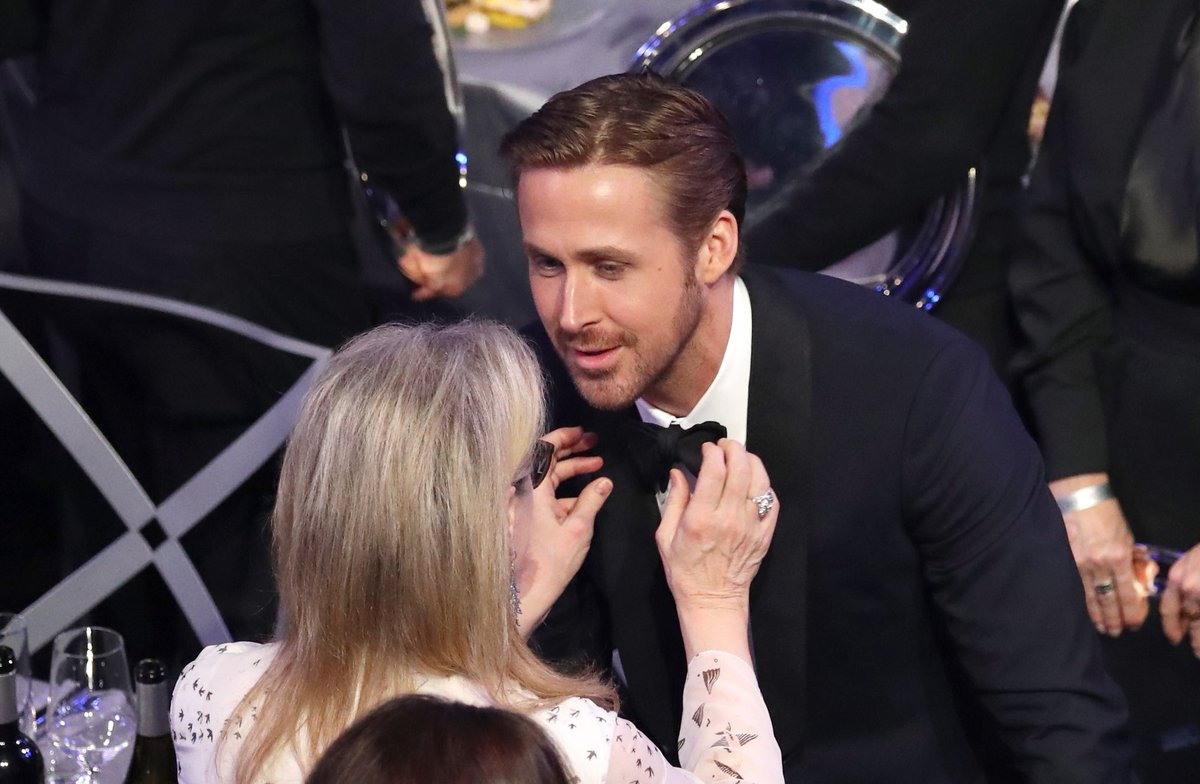 photo from Twitter
Why? What makes it so appealing that multiple cell phones were snapping away and posted the moment? Meryl is such a goddess among actors that her doing ordinary, human things is always heart-warming. It brings both of them down from the big screen and seem more like ordinary people. But it is also just so her.
Perhaps it is especially so right now because of the contrast with a certain "Man Who Would Be King" but was only elected president, who seems not to have a humble bone or nerve in his body.
The truth is: Meryl Streep is really just like that. Talk about "six degrees of separation" -- I know her with only one degree of separation -- i.e., I know someone who knows her. When they were making the movie of the book, The Hours, in which she starred, a lot of it was filmed in London. The author of The Hours (Michael Cunningham) and his partner -- my friend and New York psychoanalyst-colleague (Ken Corbett) -- were there and "spent time hanging out with Meryl." Ken says she is just as down to earth and wonderful as people say she is.
More from the SAG Awards. These awards really count in the acting world, because this is a guild of actors, voting on awards only to actors. So it's actors judging and rewarding fellow actors. This year, I had seen more of the nominated movie entries than usual; and, as usual, I don't know most of the people who are up for television roles. So I'm only reporting on movie awards.
Last year there was a big flap about the very few nominations of African-Americans at the Oscars. If that was due to bias in choices of movies to make, of casting for those movies, or of the nomination process, then it should be corrected. And they did make some changes, by broadening the eligibility of who votes for the Oscars. But there also are just going to be ups and downs, from year to year, in any characteristic you choose to look at, whether it's race or age or whatever.
This year was a particularly good year for black actors. In fact, it was a great year because of the films that were made -- three of the Best Picture nominees were stories about black people and how being black affected their lives. Those films provided some great roles for black actors, and some great acting resulted -- and led to Oscar nominations. It wasn't just that Hollywood decided to vote for them to make up for last year..
For the movie division, among the four individual acting awards, Emma Stone was the only white winner -- for Best Female Actor in "La La Land." Denzel Washington won Best Male Actor for "Fences." Viola Davis won Best Female Actor in a Supporting Role for "Fences," and Mahershala Ali won Best Male Actor in a Supporting Role for "Moonlight." In addition, the ensemble of actors that won the Cast Award for "Hidden Figures" were mostly black, including all three of the principle roles in the film.
Ralph
photo from TwitterWhy? What makes it so appealing that multiple cell phones were snapping away and posted the moment? Meryl is such a goddess among actors that her doing ordinary, human things is always heart-warming. It brings both of them down from the big screen and seem more like ordinary people. But it is also just so her.
Perhaps it is especially so right now because of the contrast with a certain "Man Who Would Be King" but was only elected president, who seems not to have a humble bone or nerve in his body.
The truth is: Meryl Streep is really just like that. Talk about "six degrees of separation" -- I know her with only one degree of separation -- i.e., I know someone who knows her. When they were making the movie of the book, The Hours, in which she starred, a lot of it was filmed in London. The author of The Hours (Michael Cunningham) and his partner -- my friend and New York psychoanalyst-colleague (Ken Corbett) -- were there and "spent time hanging out with Meryl." Ken says she is just as down to earth and wonderful as people say she is.
More from the SAG Awards. These awards really count in the acting world, because this is a guild of actors, voting on awards only to actors. So it's actors judging and rewarding fellow actors. This year, I had seen more of the nominated movie entries than usual; and, as usual, I don't know most of the people who are up for television roles. So I'm only reporting on movie awards.
Last year there was a big flap about the very few nominations of African-Americans at the Oscars. If that was due to bias in choices of movies to make, of casting for those movies, or of the nomination process, then it should be corrected. And they did make some changes, by broadening the eligibility of who votes for the Oscars. But there also are just going to be ups and downs, from year to year, in any characteristic you choose to look at, whether it's race or age or whatever.
This year was a particularly good year for black actors. In fact, it was a great year because of the films that were made -- three of the Best Picture nominees were stories about black people and how being black affected their lives. Those films provided some great roles for black actors, and some great acting resulted -- and led to Oscar nominations. It wasn't just that Hollywood decided to vote for them to make up for last year..
For the movie division, among the four individual acting awards, Emma Stone was the only white winner -- for Best Female Actor in "La La Land." Denzel Washington won Best Male Actor for "Fences." Viola Davis won Best Female Actor in a Supporting Role for "Fences," and Mahershala Ali won Best Male Actor in a Supporting Role for "Moonlight." In addition, the ensemble of actors that won the Cast Award for "Hidden Figures" were mostly black, including all three of the principle roles in the film.
Ralph
Subscribe to:
Posts (Atom)